
Cyrus Casting Cooling Conveyors
Cyrus Equipment
Cyrus Equipment
-
 Circular motion vibrating screen
-
Crusher Pre-Separation Screen
-
FlipWave™ Flip Flow Screen
-
Hydraulic lifting / tilting device
-
Mobile charging machine
-
Vibrating trough feeder with unbalanced motor
-
Vibratory Feeding Conveyors for Size Reduction
-
Cyrus Vibrating Trough Conveyor
-
Apron Conveyor
-
Vibrating Trough Conveyor
-
Vibratory Bowl Feeder
Foundry Conveyors
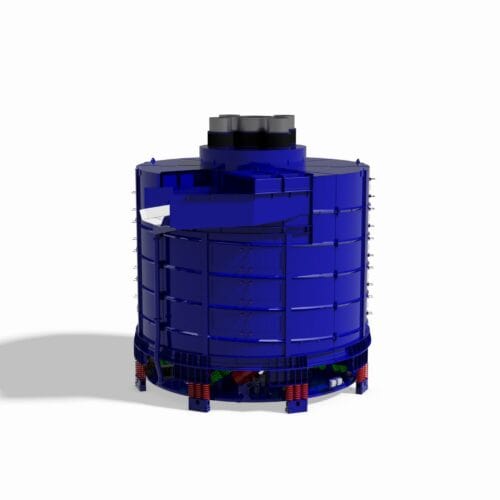
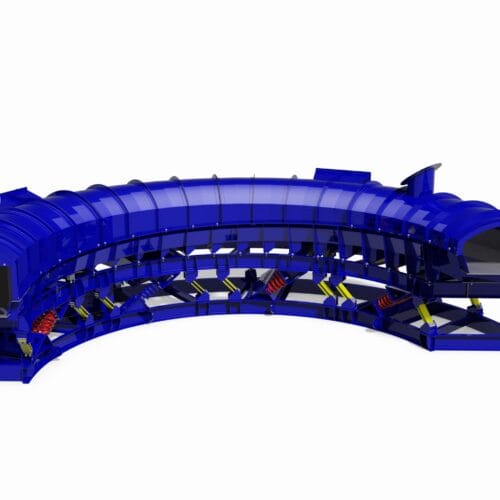
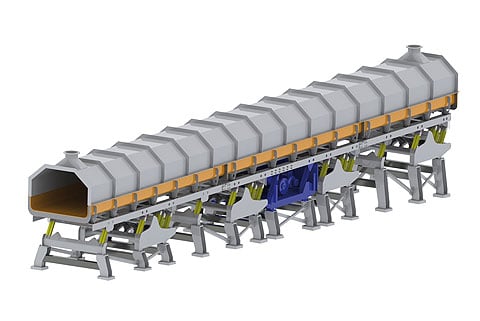
Casting Coolers
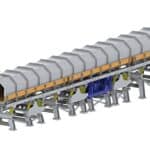
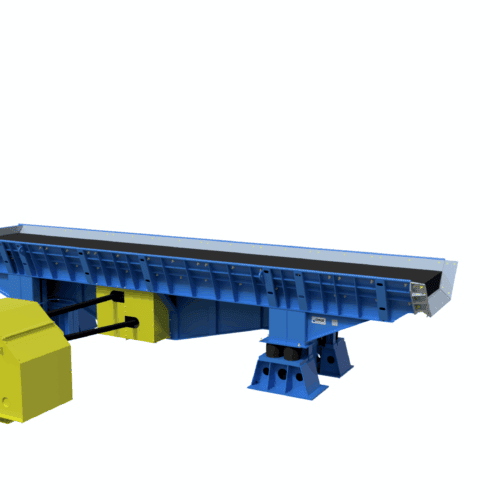
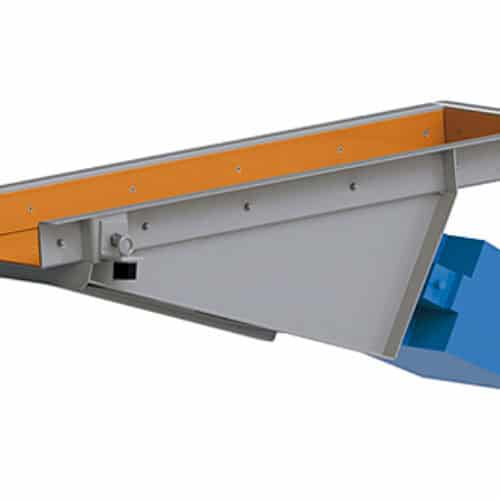
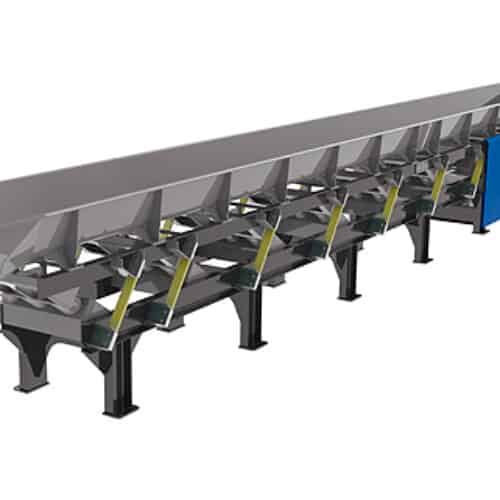
Casting coolers are designed to cool cast parts after being freed from sand from approx. 500 – 650 °C down to 100°C. This allows castings to be treated directly in the downstream shot-blasting plant. Material handling here is based on resonance trough conveyors. As a rule, these are built with vibration absorbers and screwed-on hoods that follow the vibration movement. In a counter-current process, air generated by a ventilator is blown in. The channel-type design of the resonance trough enhances airflow. A powerful cold air stream is introduced into the flow channel in the opposite direction to the casting conveyance to cool the cast parts. This cooling process can be assisted, depending on the application, by a temperature-controlled water-spraying system.
Based on resonance trough conveyors, Cyrus Casting Coolers & Conveyors are designed to cool cast parts after removal from sand of approximately 500-650 ºC down to 100 ºC. By adequately cooling castings, they can be safely treated directly in the downstream shot-blasting plant. This cooling process can be assisted, depending on the application, by a temperature-controlled water-spraying system. In a counter-current process, air generated by a ventilator is blown in. The channel-type design of the resonance trough enhances airflow. A powerful cold air stream is introduced into the flow channel in the opposite direction of the casting conveyance direction to cool down the cast parts.
Our Casting Coolers are built for safe operation, with vibration absorbers and screwed-on hoods that follow the vibration movement to contain silica and other dust. These absorbers reduce the force transmitted to the foundation, making it structurally sounder.
Depending on the casting module (ratio of casting volume to casting surface), a dwell time for the casting range is determined and controlled via the cooler’s conveyance speed.
- FEATURES
- BENEFITS
- TECHNICAL INFO
- APPLICATIONS
FEATURES
- Product-saving handling of cast parts by low-frequency low-friction conveyance
- Low wear
- Easy transport thanks to machine parts that can be disassembled
- Short time for assembly and commissioning
- Vibration absorbers largely avoid dynamic loads on the foundation
- Rugged design
- Temperature of goods to be conveyed up to 650°C
BENEFITS
The advantages of casting coolers over conventional cooling via free convection without active air supply are:
- Significantly more effective cooling for any given throughput and temperature difference
- Shorter conveying distances
- Minimisation of interfaces and therefore less cast part handling
- Less production area required for cooling cast parts
- Fewer hazard points by encapsulation
- Compact plant
Technical INfo
- Length of individual machines up to 60 m
- Width between 500 and 3,200 mm
APPLICATIONS
After pouring into the moulding line, the mould faces are pushed onto the upstream chute separator at a predetermined cycle time, where castings and sand are separated. From the chute separator, the castings are fed into the casting cooler, where they are cooled to below 100°C or to any other desired temperature, as required by the downstream process. Thanks to continuous, product-saving handling, the castings safely reach the downstream shot-blasting plant, where any soiling is removed from their surfaces.